The Hidden Geometry of Freedom: Kant meets Yoga
Why true autonomy is found in discipline, not desire.
Diana Melian
5/10/20262 min read
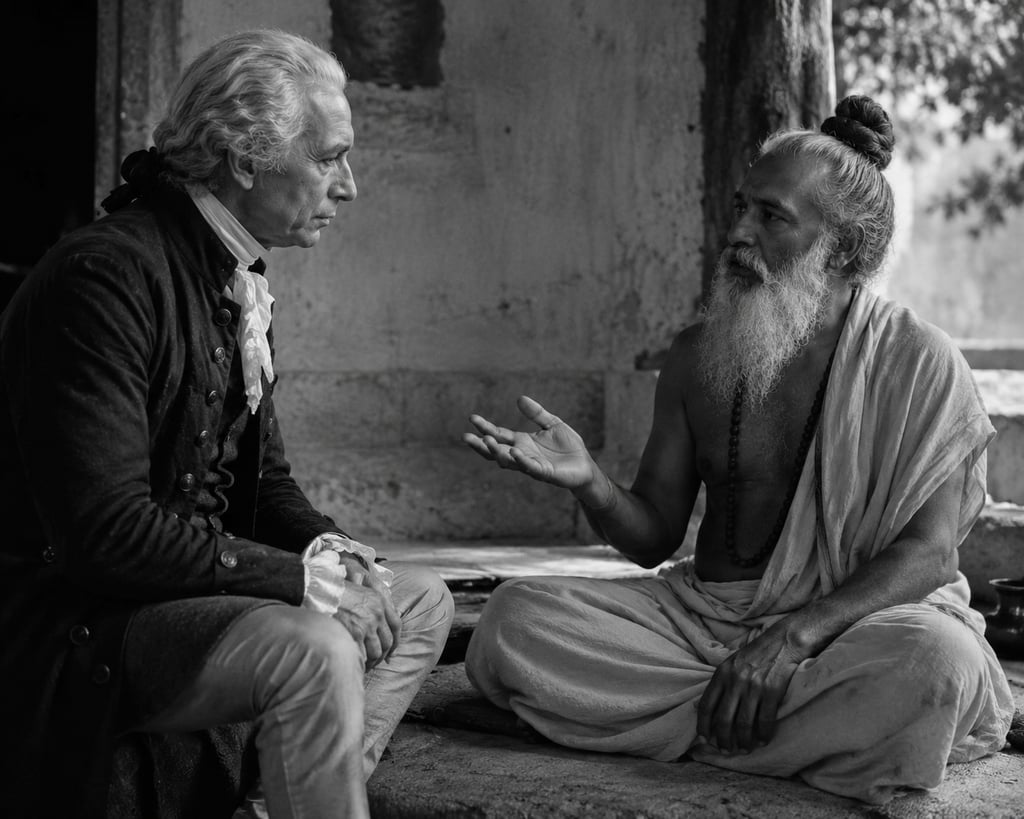
One of the most fascinating things about philosophy is realizing that thinkers separated by thousands of years, and entire civilizations, often arrive at the exact same truths.
The ancient yogis of India and the 18th-century philosopher Immanuel Kant lived in different worlds: different languages, different religions, different eras.
Yet, when you place Kant’s work beside the Yoga Sutras or the Bhagavad Gita, the parallels are impossible to ignore. They both arrived at a radical conclusion: Most people aren’t actually free.
1. The Power of Being Outcome-Independent
Kant famously gave us the "Categorical Imperative." He argued that an action is only truly moral when it is done because it is right, not because of what we gain from it.
Not for praise.
Not for reward.
Not even for happiness.
Thousands of years earlier, the Bhagavad Gita taught Nishkama Karma: acting without attachment to the "fruits" of your labor.
In modern terms, this is being Outcome-Independent. The message is identical: Do what is right because integrity matters more than the result. When you stop obsessing over the "win," you finally gain power over the process.
2. Separating the Signal from the Noise
Kant argued that humans never perceive reality directly. We see the world through the "filters" of our own mental categories.
Ancient Yoga says the same. The Yoga Sutras teach that human suffering stems from Citta-Vritti—the constant fluctuations and distortions of the mind.
Anxiety distorts reality.
Ego distorts reality.
Fear distorts reality.
Yoga isn't about changing the world; it’s about quieting the noise so you can finally perceive the signal. It is the original science of clarity.
3. Escaping "Dopamine Slavery"
Modern culture defines freedom as the ability to fulfill every desire. Kant and the Yogis would say that is actually the definition of slavery.
If you cannot control your cravings, your distractions, or your emotional reactions, are you truly free? Or are you just a passenger in a body driven by biology and dopamine?
The yogis called it Mastery. Kant called it Autonomy.
Both agree: The highest human potential emerges only when the higher self governs the lower impulse. This isn't about repression; it’s about conscious discipline.
The Bottom Line
We live in a world engineered to weaken our attention and overstimulate our desires. We are being trained to seek external validation at the click of a button.
Yet, across the centuries, these masters whisper the same truth:
A person ruled by every passing desire is not a master; they are a servant.
True freedom doesn’t begin when you get what you want. It begins the moment your consciousness becomes stronger than your impulses.
Stay Connected
Follow Sadhana
© 2026 Maha Sadhana Group, LLC. All rights reserved.